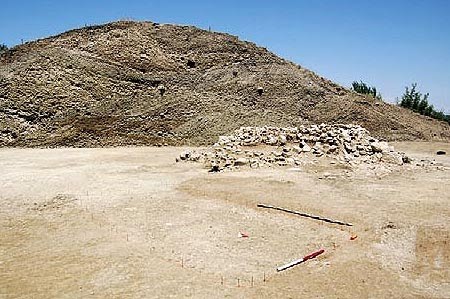
Family Cemetery in a Roman Period Tumulus near the Village of Borissovo, Elhovo Region
The large number of various and luxurious grave goods and personal belongings found in the graves, most of them being imports; show that the buried people had been representatives of the Thracian nobility. Most probably they had been members of a wealthy aristocratic family living in one of the villas situated near the present-day village of Borissovo during the second half of the 1st – the early 2nd century AD.
The fifth field season of the Strandzha expedition, within whose frames a team headed by Daniela Agre (NIAM-BAS) is making systematic archaeological excavations of tumuli in the Elhovo region. The tumulus is part of a big cemetery situated near the village of Borissovo. It was 8 m high and its diameter was 60 m. Seven burial structures and two pits were discovered under the tumulus. One of the pits yielded a chariot together with the skeletons of a couple of harness horses and the second one – the skeletons of two riding horses. The chariot was completely preserved. It was placed in a pit measuring 2.80×6.20 m, 1.40 m deep. The long axis of the pit was north-south oriented and its northern part was slanting making it easy to drive in it the cart and the horses.
Because of the narrowness of the pit, the spokes of wheels had been broken, the wheels had been detached and placed at the walls of the pit. As a result of this action, the naves remained attached to the axles. In contrast to the wheels, the framework and the basket of the cart rested on their original places. The cart was supported by stones in order to be fixed in upright position. The fact that the axels, the framework and the basket of the cart were preserved in situ provided opportunity to define very precisely its type as well as the location of its parts.
The cart has no suspension; it is four-wheeled, with a short basket and a seat and is a very luxurious vehicle indeed. It was aimed to carry a charioteer (driver) and a passenger. At the front the basket was open; the two long sides of the basket are provided with timber beams, strengthened in the upper part with iron rims. The seat is at the back side of the basket.
All reconstructions of carts made until present were based on the assumption that this was a closed type of vehicle. The discovery of the Borissovo chariot offers the possibility to revise the reconstruction of this type of ancient vehicle. The surviving wooden and leather parts of the cart provide opportunity to define all details of its construction.
There is a boot (storage compartment) situated behind the back edge of the seat. It is a new element of the construction of this cart type. Until now it was believed that there were luggage boxes, which were attached to the four-wheeled carts. The boot found in situ proves that it was part of the Roman cart construction. Besides being there, the boot of this cart was full. A bronze ellipsoid pan and a set of a bronze ladle and a bronze strainer with long handles were lying on the bottom of the boot. There were also an iron grill on which were placed four prismatic and a large spherical glass bottles. Red slipped vessels – a small pitcher, a jar and a bowl – were placed in front of the bottles. A clay mortarium was found on top. The bronze artefacts are Italic imports. The bronze ladle is stamped on the handle with the name of the manufacturer. The four prismatic glass bottles were made by blowing in a mould and had been used for transporting and storing commodities. The large spherical glass bottle finds parallels in the Eastern Mediterranean and was most probably manufactured in a Syrian atelier.
The analysis of the position of the horses in front of the cart provided the conclusion that they had been killed in the pit. The horses were buried with lavishly decorated harnesses and a yoke. The iron bars were placed on the horses’ heads. The shape of the yoke can be reconstructed after the few traces of wood, the yoke rings found in situ and the silver ornaments of the horse collars. The yoke is abundantly decorated with bronze appliqués and has 13 bronze rings. The central ornament of the cart – an exquisite figurine of a panther on a solid bronze stand – was found on the shaft, between the skeletons of the two horses. A skeleton of a dog was unearthed behind the cart, tied up to it with a chain.
The chariot is dated back to the late 1st – the early 2nd century AD.
A second pit, which yielded two sacrificed riding horses of the Thracian warrior, was excavated immediately to the south of the first one. The horses’ skeletons were lying in an anatomical order next to each other. The iron bars were found between the horses’ teeth and the bronze halters and the ornaments of the horse collars were taken and thrown on top of their bodies. There were timber shields with solid bronze shield bosses placed on the lower part of the horses’ bodies. The shields are round, 1 m in diameter. They were covered with animal hide, fixed to the wooden part with bronze rivets.
East of the pit with the riding horses, the grave of the warrior, the owner of the chariot and the horses, was discovered under a special burial stone structure – a stone revetted tumulus, whose entrance faced the south. His body had been cremated there, in a two-stepped pit. The body had been placed on a special litter covered with a textile. The deceased had been buried in full armour: six iron spears, two swords, a poniard and spurs. One of the swards is double-edged and is 0.98 m long. It had been suspended on a leather strap decorated with gilded silver appliqués; its scabbard ends with a bronze tip with tracery patterns. On the knees of the deceased there were round bronze lamellae (probably used as greaves), which overlaid some kind of fabric. Two bronze silver-plated fibulae were found at the left shoulder and a highly patinated and burnt bronze coin was lying at the skull.
The medical and sporting accessories are represented by a bronze toilette box and two iron strigils. The strigils have iron strigil holders and before being placed into the grave pit, they had been wrapped into a textile. The toilette box has two bronze tubuses. In a special drawer of the box there are medications crushed into powder and medical instruments made from bronze.
Apart from being a warrior, the deceased had been a literate person. A ink-well, a bone tablet made of bone, a bronze stylus tied up with a chain to the tablet as well as a spatula, which would have been used to spread wax onto the writing tablet, had been laid beside the body.
Ceramic vessels and glass lacrimaria had been put at various places in the grave pit.
Solid bronze vessels had been placed as grave goods on the upper step of the grave pit – amphora, podanipterus, oinochoe, two casseroles, bowl and patera as well as luxurious ceramic and glass vessels. The oinochoe was placed in the patera – this typical set was most probably related to the libatio ritual (for water and wine libation). An extremely exquisite silver diadem was discovered next to the podanipterus covered by a red slipped bowl. Gilded medallions representing two human faces facing each other are stamped on the diadem. The appliqués on the leather strap of the long sward bear the same images. The diadem, which was undoubtedly a ceremonial jewel, indicates the high social status of the deceased. The luxurious grave goods and the burial ritual provide ground to accept that the deceased was a Thracian nobleman, a warrior-cataphractarius, a wealthy and educated member of the community, who had had a high social status. He had probably been an officer in the Roman army in the second half of the 1st century AD. Although Thrace had already been turned into a Roman province in this period, the Thracian aristocracy had kept its privileges.
Seven burials were unearthed under a stone structure in the center of the tumulus. Three of them yielded skeletons of adults and the grave goods provide ground to suggest that these were females. The shallow, rectangular grave pits yielded cremation burials and the cremation ritual had been performed in them.
The central burial is a female one. The dead body had been placed on a timber stretcher covered with a textile. The deceased had been buried with a large number of bronze, ceramic and glass vessels as well as with bronze, glass and bone personal ornaments. All bronze vessels had been ritually cut into pieces (killed) before being placed into the grave pit. The bronze appliqués for toilette boxes comprise beautiful figurines of eagles and swans, masks of satires and deities, busts of deities, etc. The burials yielded remains of wallnuts and raisins.
The second female burial yielded a skeleton of a young woman, which also had been laid on a timber stretcher covered with a textile. The woman had leather shoes decorated with gold foil. The grave goods include ceramic and glass vessels, an exquisite bronze mirror, a bone spindle with a bone spindle whirl for fine spin, a bone comb, a bronze hair pin and a miniature bronze spoon. Pieces of textiles were found at different places of the grave pit. Various textiles were found in the rest of the burials of adults as well.
Three of the burials are children’s ones and contained bones of babies. They had been buried in timber coffins, placed in grave pits. The grave goods comprise glass and ceramic vessels as well as bronze mirrors. The fact that the children were the only ones who had not been cremated indicates that they had been treated with a special care.
The last burial in this group is the cremation burial of a juvenile. Part of the cremated bones had been gathered and placed in a krater-shaped vessel. An amphora was placed in the grave pit as a grave gift.
Two large triznae were unearthed at two spots among the burial structures. They consisted of local and imported pottery as well as large ruminants. The triznae are connected with the female burials.
The excavations provided favorable conditions for observations on the function (which was not clear until present) of the special stone structures abutting the stone structures of the graves. These structures yielded complete food and drinking ceramic vessels, which, in my opinion, are related to commemoration rituals. It was the place where the alive got connected to the souls of the dead by rituals including symbolic feeding. Such small stone structures are found in all tumuli yielding rich burials in the Strandzha Mountain in the Roman period.
The large number of various and luxurious grave goods and personal belongings found in the graves, most of them being imports; show that the buried people had been representatives of the Thracian nobility. Most probably they had been members of a wealthy aristocratic family living in one of the villas situated near the present-day village of Borissovo during the second half of the 1st – the early 2nd century AD. It was probably possible to access each grave for a long period of time since they were not covered by a heaped pile of earth. This statement is supported by the triznae as well as by the fact that the graves do not overlap. They abut each other and each of them is covered by a separate stone structure. However, they are not contemporary because the periphery of one of the children’s graves slightly disturbs another children’s grave. After burying the Thracian warrior-nobleman (in the late 1st – the early 2nd century AD), who had probably been the head of the family as well, a huge pile of earth was heaped on the graves. The tumulus served as a cemetery of this family only. It yielded no other graves or structures.
The important discoveries made by the archaeological team were highly valued by the Government and the Ministry of Culture of the Republic of Bulgaria as well as the Bulgarian Academy of Sciences. Funds were granted for an emergency conservation of the cart and the horses’ skeletons in the two pits as well as for constructing a temporary shelter protecting them against the hazards of the weather. A museum is planned to be constructed on spot in the next season. Since it will be the first museum of the ancient cart in Bulgaria, we consider it an important achievement of the Bulgarian archaeology.
Fuente: Bulgarian Academy of Sciences: http://www.alphagalileo.org/ViewItem.aspx?ItemId=76997&CultureCode=en

 Plovdiv's Roman Stadium is due to undergo an overhaul worth some 700 000 leva, with restoration works due to be completed by December 15 2011, reports in Bulgarian media said on May 10.